
Google Ads is one of the most powerful advertising tools in modern marketing. But its strength is not only in reaching millions of users. The main thing is the ability to show ads to those who are already looking for the right product or service right now.
However, simple registration in Google Ads does not guarantee sales. In order for advertising to work for results, dozens of nuances must be taken into account: from choosing the right keywords to optimizing bids and the structure of campaigns. This is what separates campaigns that bring profit from those that simply eat up the budget.
Why Google Ads remains one of the most effective channels?
When a person types a query into Google, they are already demonstrating a specific interest or need. And search advertising allows you to catch this moment instantly. That is why display on the search network often gives much higher conversions than, say, advertising on social networks, where we work with a cold audience.
 In addition to search advertising, Google offers many other opportunities: advertising in the contextual media network (CMM), on YouTube, in Gmail, in mobile applications. This allows you to combine different approaches: to work both on a direct request, and on brand recognition, and on re-attracting customers through remarketing.
The main thing is to understand that Google Ads is not a single tool, but a whole ecosystem of possibilities. And the effectiveness of advertising depends on how accurately you build campaigns for your goals and audience.
What should be taken into account to effectively set up advertising in Google Ads?
In order for Google advertising to work, it is important to understand: there are no small things here. Each stage of adjustment affects the result. Here are the main tasks to close:
- Choose the right campaign strategy. Search, media, video, remarketing — each type of advertising has its own characteristics. If the main goal is applications or sales, it is worth choosing the right bidding strategy and campaign format.
- Conduct in-depth keyword research. You should not focus only on obvious requests. It is necessary to find requests of medium and low frequency, collect negative words, determine the most profitable options for cost optimization.
- Competently structure campaigns. One big campaign with dozens of different ads is not the best option. It is better to create separate campaigns or ad groups by topic to ensure high relevance and better control of bids.
- Prepare quality announcements. The ad text should not just repeat keywords. It should meet the user’s request, clearly demonstrate the value of the offer and make them want to click.
- Optimize landing pages. The ad brings a person to the site. But it is the page that decides whether a conversion will happen. The page should be fast, convenient and as relevant as possible to the request.
- Set up conversion tracking. Without analytics, it is difficult to assess which queries are profitable and which are just expenses. Correct setting of conversions and goals in Google Ads and Google Analytics is a mandatory stage.
- Prepare a plan for regular optimization. Advertising on Google is a constant job. It is necessary to analyze search queries, disable ineffective keywords, adjust bids, test different options for ads and landing pages.
Everything seems simple on paper. But in reality, each of these stages requires time, knowledge and attention to detail.
Algorithm for launching ads in Google Ads
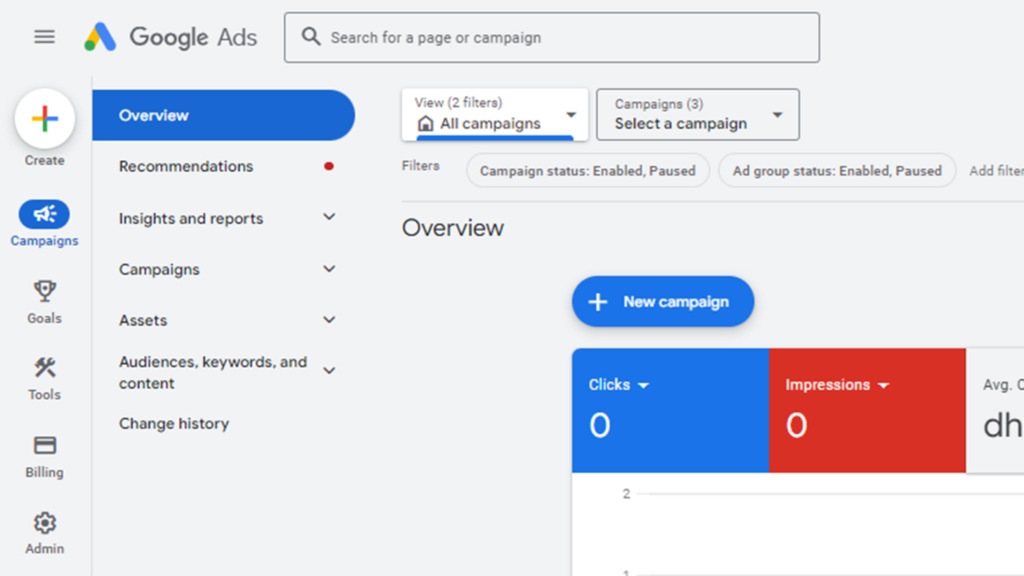
- Go to ads.google.com and sign in to your account.
- Click on “Create campaign” and choose “Expert Mode”.
- Select a goal (such as traffic, sales, or applications) and a campaign type (such as search).
- Set a budget and bid strategy.
- Configure geotargeting (where to show ads) and language.
- Create ad groups and add keywords.
- Write the ad: headlines, description, links.
- Add ad extensions (if needed).
- Set up conversion tracking or connect Google Analytics.
- Check all settings and click Publish.
Why is it better to hire specialists to set up ads in Google Ads?
At first glance, it seems that Google itself helps with the setup: it prompts the audience, recommends bids, offers automation. But these tips don’t always work in your best interest. Often, the system offers more expensive solutions or ones that are focused on maximizing clicks rather than achieving your real business goals.
A specialist sees the bigger picture: he analyzes competitors, studies the niche, correctly allocates the budget between different campaigns, selects bid strategies depending on the type of requests and the specifics of your product. Ads and keywords are also optimized not at random, but taking into account seasonality, behavioral factors and expectations of the target audience.
In addition, a professional setup allows you to avoid common mistakes, such as wrongly working with negative keywords, too broad audiences, or inefficient bidding. And this directly affects the cost of the application and the final profitability of advertising.And most importantly: the experience of a specialist allows you to save the budget already at the testing stage. Getting it right from the start means less cost, less wasted money on failed attempts, and faster results that are predictable and scalable.
We see Google advertising as more than just a traffic channel. We perceive it as a tool for business development. Therefore, we take a comprehensive approach: we analyze your niche, research competitors, develop a campaign strategy, adjust advertising and constantly optimize it.
We work for results: applications, sales, growth of your business. No empty promises — only clear analytics and real numbers. Do you want your Google ads to start bringing results, and not just waste your budget? Contact PRY.AGENCY – we will help you take the first step towards effective growth.